Skip to timeline

Since 1917

Rado History

From a family workshop in Lengnau to a global design-led watchmaker, Rado has built its identity through technical courage, material innovation and unmistakable form.

Explore the eras
Scroll to explore

A chronological archive

Materials, design and innovation in motion

This prototype follows the cleaned historical chapters: origins in Lengnau, the material revolution, the design era, modern ceramic engineering and the values that define Rado today.

1917-1937

Origins and Foundations

Born in Lengnau, Switzerland. Imagined for the world.

Origins

Schlup & Co. begins in Lengnau

Friedrich, Ernst and Werner Schlup transformed the attic of the family farmhouse in Lengnau into a watchmaking workshop. The company produced hand-wound and lever movements, building its reputation on precision, adaptability and Swiss craftsmanship.

Archive portraits of Friedrich, Ernst and Werner Schlup, founders of Schlup and Co.
Archive portraits of the Schlup founders.

Workshop

Expansion and incorporation

Schlup & Co. became a public limited company, marking a new stage in its professional development. The business remained modest in size, but its export orientation was already central to its growth.

Black and white archive image of watchmakers working at long benches in Lengnau.
Lengnau workshop archive image.

1950s-1961

A Brand Looks Outward

The Rado name moved from a protected mark to the identity of a growing international watch brand.

Brand identity

The Rado name gains a public face

The Rado name had been protected in 1928, but the late 1950s marked the moment when it began to take on a clearer brand identity. Archive material shows Rado expanding into markets including Hong Kong, Thailand, Korea and Japan.

A 1957 Rado advertisement with an early Rado logo and archive number.
Early Rado advertising from 1957.

Early collections

Green Horse, Golden Horse and named models

The early Rado collections helped define the brand's move from movement maker to watchmaker. The archive material suggests care here: Green Horse appears first in 1960, while Golden Horse followed in 1961 with gold-plated details and the two-seahorse dial emblem.

Archive catalogue spread showing Captain Cook, Over-Pole, Golden Horse and Green Horse watches.
Early Rado named models in archive catalogue material.

1962-1986

The Material Revolution Begins

When others saw limits, Rado saw the materials of the future.

Materials

DiaStar and the scratchproof idea

In 1960, Rado filed a patent for a hardmetal watch case. Suppliers considered the idea impossible, but Rado persisted. In 1962, DiaStar turned that vision into reality, combining hardmetal with sapphire crystal.

Continue to ceramic
Archive product image of the Rado DiaStar watch with hardmetal case and faceted crystal.
DiaStar archive product image.

Adventure

Captain Cook and Over-Pole enter the story

Captain Cook and Over-Pole were part of Rado's early 1960s wave of named models, reflecting the period's appetite for exploration, water resistance and travel-oriented functions.

Archive catalogue spread with Captain Cook and Over-Pole models among early Rado watches.
Captain Cook and Over-Pole in early archive material.

1970s-1990s

The Design Era

Square forms, edge-to-edge sapphire, anatomical shapes and black ceramic gave Rado a design identity of its own.

Sapphire crystal

Edge-to-edge sapphire changes the form

DiaStar 67, known internally as Glissiere, introduced edge-to-edge sapphire crystal between hardmetal plates. It helped Rado create a sharper and more architectural design language.

Archive product image of the rectangular DiaStar 67 with edge-to-edge sapphire crystal.
DiaStar 67, also known internally as Glissiere.

Anatomical design

Anatom and the curved sapphire concept

Anatom gave sapphire crystal a curved ergonomic form. The archive drawings show a watch shaped around the wrist rather than a flat case adapted to it.

Technical drawing of a curved sapphire crystal for an anatomical Rado watch design.
Technical drawing for the curved sapphire crystal.

High-tech ceramic

Integral confirms a new ceramic direction

The idea that became Integral began with an anatomical watch concept and a new lightweight, scratch-resistant bracelet. In 1986, Rado confirmed the use of high-tech ceramic for the bracelet, setting the brand on a path that would transform its future.

Internal Rado memo dated 22 May 1986 referencing changes for Integral and ceramic bracelet parts.
Internal 1986 document for Integral development.

Design icon

Ceramica turns ceramic into a pure design statement

Ceramica, launched in 1990, transformed high-tech ceramic into a black, bracelet-like icon. Created with designer Werner Scholpp, it helped establish Rado's ceramic identity through the 1990s and 2000s.

See the modern material story
Archive image of the black Rado Ceramica watch launched in 1990.
Ceramica, 1990.

2000s-Present

Modern Innovation and Global Identity

Innovating tomorrow's classics.

Record-breaking materials

V10K and the pursuit of hardness

V10K continued Rado's long quest for hardness, reaching 10,000 Vickers through diamond-like surface technology. It carried the scratch-resistant idea into a new century.

Archive history wall detail showing Rado material milestones including V10K and ceramic.
Material milestones gathered from the history wall.

Thin ceramic

True Thinline explores lightness and restraint

True Thinline showed another kind of mastery: an ultra-thin high-tech ceramic watch built around lightness, precision and restraint.

Rado True Thinline white high-tech ceramic advertising image with side profile detail.
True Thinline communication image.

Color

Challenging the colors

Rado's modern ceramic story is also a color story. Through pigment research, plasma ceramic and special color collections, high-tech ceramic became a broad design palette.

Grid of colorful Rado high-tech ceramic watches arranged in individual boxes.
Archive image of the True Thinline color universe.

Heritage revival

Icons reimagined for a new generation

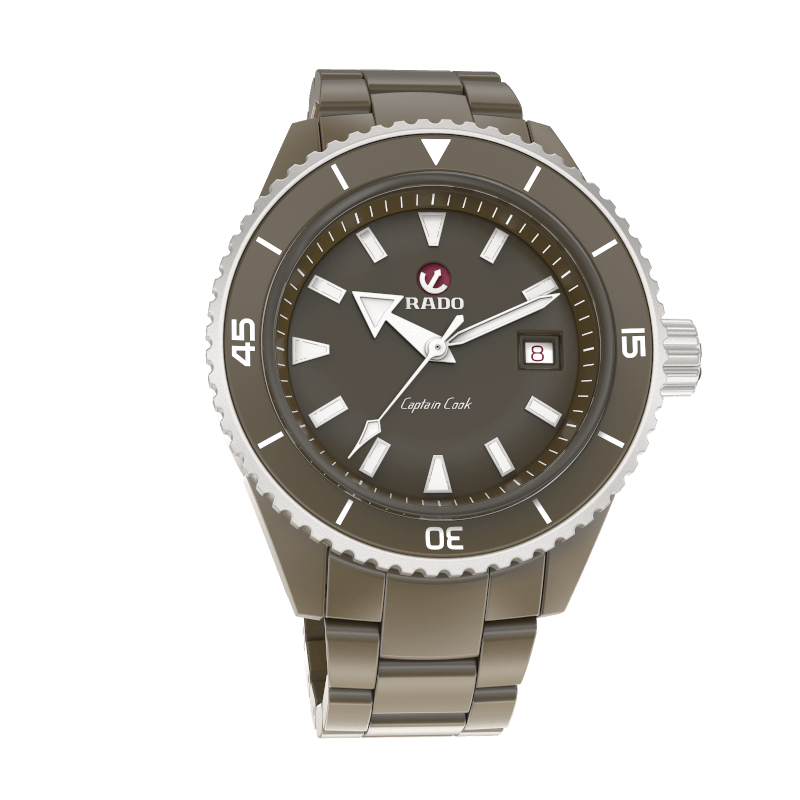
Since 2016, Rado has looked back into its archive to move forward. HyperChrome 1616, Captain Cook, Over-Pole, DiaStar Original and Anatom show how historic forms can be reinterpreted through contemporary materials and today's design language.

Modern Rado Captain Cook watch on a dark geometric background.
Modern Captain Cook.
Modern Rado Over-Pole watch with blue dial and leather strap.
Modern Over-Pole.

Our mission

Mastering Materials, Design and Innovation

Rado's mission is to imagine what a watch can become, then engineer it into reality.

Core values

What defines Rado today

Rado today is defined by Swiss precision, material expertise, design courage and a belief that innovation should be felt as much as seen. Its watches are built for lasting beauty: resistant, comfortable, recognizable and continually evolving.

  • Swiss watchmaking with roots in Lengnau.
  • Pioneering use of advanced materials.
  • High-tech ceramic expertise.
  • Design built for lasting beauty.
Modern black Rado Anatom watch shown at an angle with glossy ceramic surfaces.
Modern Anatom as a contemporary expression of an archive form.

Master of materials

The story continues through materials, design and touch.

Explore the icons, innovations and contemporary collections shaped by more than a century of Rado history.